In the Amazon, slipping on your shoes is as simple as painting a thin layer of latex on your feet. Rubber, at least in its original form, is derived from tree sap as opposed to today’s synthetic version from petrochemicals. In a way, indigenous people in the Amazon pioneered this ready-to-wear technology as the original tires for human mobility.

Now a Spanish company called OneMoment is bringing that ancient, cutting-edge technology to the rest of us. Their completely biodegradable shoe--measuring only 2 millimeters thick on the sole, and just 1 millimeters around the foot (that’s about three millimeters less than traditional shoes)--is created by injecting natural bioplymers, similar to latex, into a mold. The elastic, biodegradable material molds to your foot, and rolls up for easy storage. To clean them, you can just rinse them or wash them in the washing machine. Once they’ve lived out their natural life, you can compost them by shredding and tossing them into the compost bin.
The people who use the shoe vary widely, says Felipe Izquierdo of OneMoment by email: "Long haul travelers, back-packers in New Zealand forest, discotheque fashion lovers in the UK, mothers taking their kids to swimming lessons, hunters, scuba divers. It’s a long list." They’re currently available in 35 countries around the world, and expanding quickly.
"The idea came from the necessity to protect our feet quickly, cheaply, and in an environmentally friendly manner," says Izquierdo. The Amazon natives who inspired the shoes just covered the soles of their feet with Hevea resin, but OneMoment uses internationally certified biopolymers: "Biodegradable does not mean soft or non-rugged materials," he says. "What’s more biodegradable than a tree?"
Showing posts with label ideation innovation. Show all posts
Showing posts with label ideation innovation. Show all posts
Tuesday, April 3, 2012
A Fully Biodegradable Foldable Shoe, Inspired By Amazon Natives | Co.Exist: World changing ideas and innovation
via fastcoexist.com


Thursday, March 22, 2012
Overcoming The Quagmire of Accidental Innovation
(Please take a moment to visit our sponsors.)
On his blog Medinnovation, Dr. Richard Reece discusses the interconnectedness of innovation across domains of innovation activity in this post. It’s interesting to see his commentary on 10 coming medical innovations in this regard. It is doubly so because this phenomenon is not unique to medical innovation.
Great and transformative innovation stem from the confluence of many different advances and observations. The accumulation of knowledge into the global pool of information provides the water of life for innovation. People seeking to find novel and valuable solutions to needs draw upon this fund of knowledge to synthesize new answers. This is the act of innovation creativity in its pure form.
We should understand the consequence of this as it relates to driving sustainable innovation in the enterprise. Knowledge worker need knowledge with which to work. Connectedness to knowledge of all types is an essential ingredient to create the working environment needed to drive continuous, value creating innovation. This must include seamless access to the enterprise’s internal knowledge, global knowledge from both inside and outside the company’s domain of expertise, and the tacit knowledge of team mates.
Have you ever noticed the degree of innovation serendipity? It is not by chance that different people seem to be creating the same innovation at the same time. Any really interesting, high value challenge is going to attract many potential innovators. Don’t flatter yourself and think you are the only one working on your great project. Also, many potential innovators have access to the same informational resources that you do. This means there is a reasonable chance that when you find a great solution, you won’t be alone.
Yet, it is also the case that most potential innovators have the same poor access to knowledge that you do. This means that you have an opportunity to create an innovation edge. By investing in establishing the best innovation intelligence infrastructure—one that provides seamless access to all sources of knowledge when and how you need it—you can tilt the scales of innovation providence in your favor.
This is a key lesson that innovation leaders must take to heart. You can influence the frequency and value of your innovation outcomes by making the right strategic investments in innovation infrastructure and methods. As we begin to emerge from the past years of economic malaise, companies are all beginning to renew their innovation agenda. Will you take the right steps to ensure that your innovation workers have the right tools to deliver the goods? via innovatingtowin
Jim Woods is president and founder of InnoThink Group; a global innovation, growth and hypercompetition consultancy. He is an author and speaker on strategic innovation and competitive advantage. To hire Jim to speak to your organization - Call 719- 649- 4118 or email us for availability. Subscribe to our innovation and hypercompetition newsletter.
(Please take a moment to visit our sponsors.)
(Please take a moment to visit our sponsors.)
Follow us on Twitter
Follow us on Linkedin
Follow us on Facebook
Andrea Meyer: Collaboration Curves Improve Innovation and Performance
(Please take a moment to visit our sponsors.)
Point: Unlike the diminishing returns of the Experience Curve, Collaboration Curves offer continuous, exponential improvement and innovation through knowledge sharing and interactions among a group of participants.
Story: Most of us have heard about the Experience Curve, which traces how a company’s rising experience in making a product leads to declining cost of that making a product. On average, the cost declines 20-30 percent each time that a company’s experience in making that product doubles. The Experience Curve, which has been systematically studied since the 1960s, holds true across a wide range of industries. The sad flip-side of the Experience Curve, however, is that the rate of improvement declines over time because it takes longer and longer for experience to double. It has diminishing returns. Can anything be done to sustain the rate of improvement? Is there another way to keep on advancing? There is: Collaboration Curves.
Collaboration — in the form of knowledge sharing and interactions among a group of participants — improves the performance of all. Before the internet, collaboration took place primarily face to face, along with some letter-writing between participants. For example, in the 1870s, the art movement that came to be called Impressionism arose. A group of young painters — Claude Monet, Pierre Renoir, Camille Pissaro and others — started meeting in cafes, talking and visiting each other’s art studios. They became a collaborative group; that is, they’d share their work in progress, talk about painting techniques, experiment with colors, and help each other learn and improve.
For example, the group broke with the tradition of black shadows. They experimented with shadows painted in purple, deep blue or a mix of other colors. Sometimes the shadows weren’t even that dark. This was a radical idea — no one had painted shadows in a different color before, but once one of the group came upon it, others adopted it as well. They also expanded the notions of what could be painted. The subject matter needn’t be a religious icon, mythological scene, portrait of a nobleman or an allegorical landscape — it could be something as simple as a haystack or water lilies, painted over and over at different times or day or different seasons, showing how the light and color changes with the times and seasons. Combining their experiences accelerated the Impressionists’ innovations in color, composition, brushwork, and subject matter.
Today, these collaborative groups can extend online, enabling people to talk and share with others anywhere, any time, thereby greatly — indeed exponentially — improving the group’s capacity to produce. In the old model, the experience of any one person (or company) grew linearly with time, which created an Experience Curve with diminishing returns. But a collaborating group can multiply experiences by combining lessons from the successes and failures of all to create a Collaboration Curve that sustains performance improvement. The internet, social media, and collaboration platforms greatly enhance the Collaboration Curve by increasing the number of people who can collaborate, increasing the geographic span of people who can collaborate, and increasing the access to the accumulated experience of the collaborative group.
Collaboration Curves were first identified by John Hagel, who heads consulting firm Deloitte’s Center for the Edge in
So far, examples of internet-enabled Collaboration Curves are more anecdotal rather than rigorous because of their nascency. But Hagel has found that collaborative environments like the popular online game World of Warcraft offer participants a way to continue improving beyond what individuals could accomplish alone. In the business world, similar collaboration curves take place on SAP’s software developer sites, and large open source projects such as the Eclipse Foundation. What’s exciting is that “Collaboration curves may reverse the diminishing returns dynamics of the experience curve and deliver increasing returns to performance instead,” Hagel says. The opportunity for interactions among the many participants lets performance continue improving through the continuing contributions of ideas by other participants.
Action: Hagel found that there are three prerequisites for these online collaboration groups to work and generate the Collaboration Curve effect.
Attract Participants: First, you need people. That’s pretty obvious, that you need people to make this work. But what’s exciting is that the people don’t all have to be talking or active all the time – it’s perfectly ok to begin by just being an observer who lurks and learns from others. Indeed, in SAP’s software developer network (SAP SDN), most participants do just that — learning by reading the discussion forums before they contribute anything themselves.
Interact: to get better results, you start interacting with others, in discussions — in person or online — sharing experiences, making suggestions, giving feedback. The more interactions, the faster the performance improvement.
A supportive, multi-layered environment: Supportive means friendly and online. It also means that the technology supports the interaction through discussion boards, archives, live chats, video. Interaction must be easy not only among peers but among all cross-cutting groups. Digital infrastructure lowers interaction costs, enabling large, diverse groups of people to share information and learn from each other, driving performance improvements for all.
Jim
Woods is president and founder of InnoThink Group; a global innovation, growth and hypercompetition
consultancy. He is an author and speaker on strategic innovation and competitive advantage. To hire Jim to speak to your organization - Call
719- 649- 4118 or email us for
availability.
(Please take a moment to visit our sponsors.)
Follow us on
Twitter
Follow us on
Linkedin
Follow us on Facebook
C.K. Prahalad: The Fortune at the Bottom of the Pyramid
(Please take a moment to visit our sponsors.)
With the end of the Cold War, the former Soviet Union and its allies, as well as
First, the prospect of millions of “middle-class” consumers in developing countries, clamoring for products from MNCs, was wildly oversold. To make matters worse, the Asian and Latin American financial crises have greatly diminished the attractiveness of emerging markets. As a consequence, many MNCs worldwide slowed investments and began to rethink risk–reward structures for these markets. This retreat could become even more pronounced in the wake of the terrorist attacks in the
The lackluster nature of most MNCs’ emerging-market strategies over the past decade does not change the magnitude of the opportunity, which is in reality much larger than previously thought. The real source of market promise is not the wealthy few in the developing world, or even the emerging middle-income consumers: It is the billions ofaspiring poor who are joining the market economy for the first time.
This is a time for MNCs to look at globalization strategies through a new lens of inclusive capitalism. For companies with the resources and persistence to compete at the bottom of the world economic pyramid, the prospective rewards include growth, profits, and incalculable contributions to humankind. Countries that still don’t have the modern infrastructure or products to meet basic human needs are an ideal testing ground for developing environmentally sustainable technologies and products for the entire world.
Furthermore, MNC investment at “the bottom of the pyramid” means lifting billions of people out of poverty and desperation, averting the social decay, political chaos, terrorism, and environmental meltdown that is certain to continue if the gap between rich and poor countries continues to widen.
Doing business with the world’s 4 billion poorest people — two-thirds of the world’s population — will require radical innovations in technology and business models. It will require MNCs to reevaluate price–performance relationships for products and services. It will demand a new level of capital efficiency and new ways of measuring financial success. Companies will be forced to transform their understanding of scale, from a “bigger is better” ideal to an ideal of highly distributed small-scale operations married to world-scale capabilities.
In short, the poorest populations raise a prodigious new managerial challenge for the world’s wealthiest companies: selling to the poor and helping them improve their lives by producing and distributing products and services in culturally sensitive, environmentally sustainable, and economically profitable ways.
Four Consumer Tiers
At the very top of the world economic pyramid are 75 to 100 million affluent Tier 1 consumers from around the world. (See Exhibit 1.) This is a cosmopolitan group composed of middle- and upper-income people in developed countries and the few rich elites from the developing world. In the middle of the pyramid, in Tiers 2 and 3, are poor customers in developed nations and the rising middle classes in developing countries, the targets of MNCs’ past emerging-market strategies.
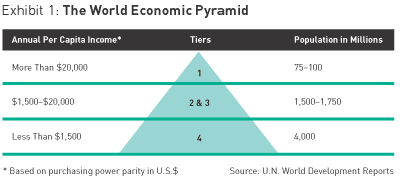
Now consider the 4 billion people in Tier 4, at the bottom of the pyramid. Their annual per capita income — based on purchasing power parity in U.S. dollars — is less than $1,500, the minimum considered necessary to sustain a decent life. For well over a billion people — roughly one-sixth of humanity — per capita income is less than $1 per day.
Even more significant, the income gap between rich and poor is growing. According to the United Nations, the richest 20 percent in the world accounted for about 70 percent of total income in 1960. In 2000, that figure reached 85 percent. Over the same period, the fraction of income accruing to the poorest 20 percent in the world fell from 2.3 percent to 1.1 percent.
This extreme inequity of wealth distribution reinforces the view that the
poor cannot participate in the global market economy, even though they
constitute the majority of the population. In fact, given its vast size, Tier 4
represents a multitrillion-dollar market. According to World Bank projections,
the population at the bottom of the pyramid could swell to more than 6 billion
people over the next 40 years, because the bulk of the world’s population
growth occurs there.
The perception that the bottom of the pyramid is not a viable market also fails to take into account the growing importance of the informal economy among the poorest of the poor, which by some estimates accounts for 40 to 60 percent of all economic activity in developing countries. Most Tier 4 people live in rural villages, or urban slums and shantytowns, and they usually do not hold legal title or deed to their assets (e.g., dwellings, farms, businesses). They have little or no formal education and are hard to reach via conventional distribution, credit, and communications. The quality and quantity of products and services available in Tier 4 is generally low. Therefore, much like an iceberg with only its tip in plain view, this massive segment of the global population — along with its massive market opportunities — has remained largely invisible to the corporate sector.
Fortunately, the Tier 4 market is wide open for technological innovation. Among the many possibilities for innovation, MNCs can be leaders in leapfrogging to products that don’t repeat the environmental mistakes of developed countries over the last 50 years. Today’s MNCs evolved in an era of abundant natural resources and thus tended to make products and services that were resource-intensive and excessively polluting. TheUnited States
We have seen how the disenfranchised in Tier 4 can disrupt the way of life and safety of the rich in Tier 1 — poverty breeds discontent and extremism. Although complete income equality is an ideological pipe dream, the use of commercial development to bring people out of poverty and give them the chance for a better life is critical to the stability and health of the global economy and the continued success of Western MNCs.
The InvisibleOpportunity
Among the top 200 MNCs in the world, the overwhelming majority are based in developed countries.U.S.
To appreciate the market potential of Tier 4, MNCs must come to terms with a set of core assumptions and practices that influence their view of developing countries.
We have identified the following as widely shared orthodoxies that must be reexamined:
Assumption #1 The poor are not our target consumers because with our current cost structures, we cannot profitably compete for that market.
Assumption #2 The poor cannot afford and have no use for the products and services sold in developed markets.
Assumption #3 Only developed markets appreciate and will pay for new technology. The poor can use the previous generation of technology.
Assumption #4 The bottom of the pyramid is not important to the long-term viability of our business. We can leave Tier 4 to governments and nonprofits.
Assumption #5 Managers are not excited by business challenges that have a humanitarian dimension.
Assumption #6 Intellectual excitement is in developed markets. It is hard to find talented managers who want to work at the bottom of the pyramid. (We suggest reading the full article via strategy-business.com starting with page 3.)
****
The perception that the bottom of the pyramid is not a viable market also fails to take into account the growing importance of the informal economy among the poorest of the poor, which by some estimates accounts for 40 to 60 percent of all economic activity in developing countries. Most Tier 4 people live in rural villages, or urban slums and shantytowns, and they usually do not hold legal title or deed to their assets (e.g., dwellings, farms, businesses). They have little or no formal education and are hard to reach via conventional distribution, credit, and communications. The quality and quantity of products and services available in Tier 4 is generally low. Therefore, much like an iceberg with only its tip in plain view, this massive segment of the global population — along with its massive market opportunities — has remained largely invisible to the corporate sector.
Fortunately, the Tier 4 market is wide open for technological innovation. Among the many possibilities for innovation, MNCs can be leaders in leapfrogging to products that don’t repeat the environmental mistakes of developed countries over the last 50 years. Today’s MNCs evolved in an era of abundant natural resources and thus tended to make products and services that were resource-intensive and excessively polluting. The
We have seen how the disenfranchised in Tier 4 can disrupt the way of life and safety of the rich in Tier 1 — poverty breeds discontent and extremism. Although complete income equality is an ideological pipe dream, the use of commercial development to bring people out of poverty and give them the chance for a better life is critical to the stability and health of the global economy and the continued success of Western MNCs.
The Invisible
Among the top 200 MNCs in the world, the overwhelming majority are based in developed countries.
To appreciate the market potential of Tier 4, MNCs must come to terms with a set of core assumptions and practices that influence their view of developing countries.
We have identified the following as widely shared orthodoxies that must be reexamined:
Assumption #1 The poor are not our target consumers because with our current cost structures, we cannot profitably compete for that market.
Assumption #2 The poor cannot afford and have no use for the products and services sold in developed markets.
Assumption #3 Only developed markets appreciate and will pay for new technology. The poor can use the previous generation of technology.
Assumption #4 The bottom of the pyramid is not important to the long-term viability of our business. We can leave Tier 4 to governments and nonprofits.
Assumption #5 Managers are not excited by business challenges that have a humanitarian dimension.
Assumption #6 Intellectual excitement is in developed markets. It is hard to find talented managers who want to work at the bottom of the pyramid. (We suggest reading the full article via strategy-business.com starting with page 3.)
****
Business
today is a chess match without rules. Requiring nimble competitiveness in which
conventional thinking is discarded. InnoThink Group is provocative. Dynamic.
Imaginative and committed to helping our clients out compete for top line
growth. Hire Jim
Woods To Speak to Your Organization.
(Please take a moment to visit our sponsors.)
(Please take a moment to visit our sponsors.)
Jim
Woods is president and founder of InnoThink Group; a global innovation, growth and hypercompetition
consultancy. He is an author and speaker on strategic innovation, education and
competitive advantage. To hire Jim to speak to your organization - Call
719- 649- 4118 or email us for
availability. Subscribe
to our innovation and hypercompetition newsletter.
Follow us on
Twitter
Follow us on
Linkedin
Follow us on Facebook
Subscribe to:
Posts (Atom)